
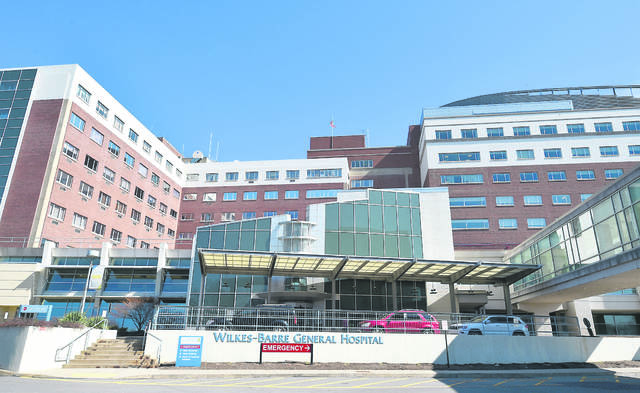
Two of Luzerne County’s three hospitals had “higher than expected” mortality or readmission rates for patients admitted with certain conditions in 2019, according to an annual report released Tuesday. The report, issued by the Pennsylvania Health Care Cost Care Containment Council, reviewed results for hospitals statewide in treating 16 categories of admissions.
The report provides the number of cases treated in a year, and whether mortality and readmission rates were within an expected range, “significantly higher” than expected or “significantly lower” than expected. For most of the medical conditions tracked, the three hospitals were within the expected ranges. But both Lehigh Valley Hazleton and Wilkes-Barre General had higher than expected rates in some categories.
Lehigh Valley Hazleton had a higher than expected readmission rate for medical management of heart attacks. It also had a higher than expected mortality rate for intestinal obstructions, a higher than expected readmission rate for kidney and urinary tract infections, and a higher than expected readmission rate for infectious pneumonia.
Wilkes-Barre General had a higher than expected mortality rate for kidney and urinary tract infections, higher than expected rates of both mortality and readmission for acute kidney failure cases, and a higher than expected mortality rate for sepsis.
Geisinger Wyoming Valley had no instances of higher than expected rates, and posted lower than expected mortality rates for four conditions: Heart failure, infectious pneumonia, respiratory failure and sepsis.
The report also looked at changes in the number cases for each condition statewide from 2014 to 2019. Chest pain admission dropped by 55% from 8,414 to 3,085. Sepsis had the biggest increase, 33%, climbing from 52,761 to 70,308.
Overall, from 2014 to 2019 mortality rates dropped in eight of the conditions, while readmission rates dropped in seven conditions.