
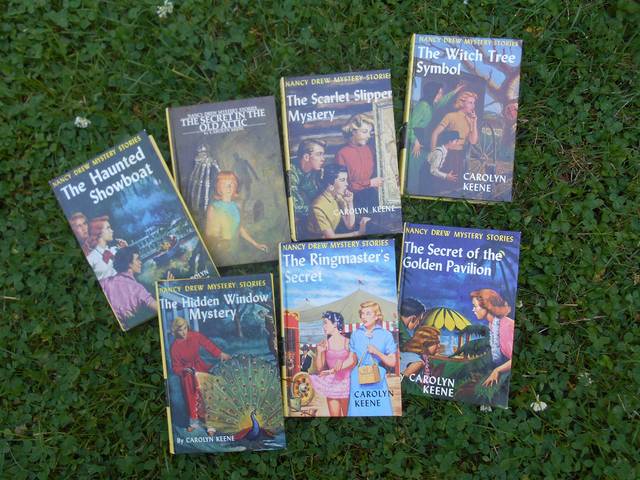
“You can’t escape,” the villain snarled at Nancy Drew, whom he had bound and gagged and locked in a room with a deadly spider. “The black widow may not come quickly, but she’ll finally find you.”
With a final, mocking “Sweet dreams!” he blew out a candle, leaving the teen-age sleuth in total darkness.
That’s the kind of tight fix in which Nancy Drew, an 18-year-old amateur detective and heroine of a series of mystery stories that debuted in 1930, often found herself.
I loved to read about her exploits, back when I was 9 or 10 and my doting grandmother could buy a yellow-spined mystery or two (by Carolyn Keene — the pen name under which several authors wrote) for $1.50 each at the old Fowler, Dick and Walker, The Boston Store — forerunner of Boscov’s in downtown Wilkes-Barre.
Decades later I still have those books, and in recent weeks I’ve pulled a few off the shelf and realized how easy it is to feel like you’re 9 years old again.
Just turn the pages and coronavirus concerns melt away. You can fly off with Nancy and her friends Bess and George to Hawaii. Or Africa. Or Scotland.
Or pile into her sporty convertible — she called it a “roadster” — and drive to somewhere like Amish Country for a mystery titled “The Witch Tree Symbol,” which was one of my favorites, perhaps because it was set in Pennsylvania.
That story line has Nancy pulling an injured farmer out of a bull pen before the animal could kill him, and pushing two children out of the way of a falling wooden beam at a barn-raising, all while finding time to reunite a daughter with her estranged parents, solve a mystery about stolen antique furniture — and pitch in frying doughnuts at the house where she and her chums are staying.
The character is so confident and capable, legions of readers have become her fans. As the Washington Post reported last year, Sandra Day O’Connor, Hillary Clinton, Sonia Sotomayor, Laura Bush and Ruth Bader Ginsberg all have been among them.
Teachers and librarians might have considered the books too easy when they were first published, but they can’t discount Nancy as a role model who consistently tries to help people, and never gives up.
The character has a fan club, jewelry patterned in her likeness and video games that celebrate her style. She appeared in movies in the 1930s and appears in a TV series that was renewed in January for a second season on The CW.
Newer versions of Nancy Drew stories are still being published, with a Nancy Drew Diaries offering called “The Vanishing Statue” set for release on Tuesday and a Nancy Drew Book Club Series offering called “The Big Island Burglary” scheduled to be released July 28.
And, now she’s reportedly modern enough to use a cell phone and drive a hybrid car.
But I’m enjoying the classic versions of Nancy — from books that credit Grosset & Dunlap for reprinting them in or around 1970.
Some of the stories were revised, even back then, but they still offer an entertaining glimpse into a long-ago era when young women attended tea dances, apparently wore dresses even when they were rowing boats, climbing trees or exploring old attics, and wrote their friends letters which they then carried to the mail box at the corner.
One aspect of the classic stories that seems especially unusual today is that Nancy and her female friends, all 18 years old, didn’t seeking further education or training after high school — though their male friends Ned, Burt and Dave, none of whom could possibly be as brilliant as Nancy, are all enrolled at Emerson College (or in some books Emerson University.)
Our heroines don’t have paying jobs, either.
Well, perhaps Nancy draws a paycheck when, talented as she is, she is able in “The Scarlet Slipper Mystery” to take over teaching a children’s ballet class because the teachers who ran the school had to go into hiding.
Or perhaps she’s paid when, quick study that she is, she’s able to fill in as a bareback rider — standing on a moving horse — when a circus performer is injured in “The Ringmaster’s Secret.”
But mostly she seems to turn down rewards and simply enjoy the satisfaction of outwitting criminals, especially the ones who tie her up and leave her in some obscure place.
Never fear. If she’s bound and gagged in the hayloft of a barn, surely she will wriggle her way over to an old scythe and saw away at the ropes. Or perhaps she’ll find a flashlight, to send a Morse Code message out the window. Or, trapped in a dark, stuffy attic with a poisonous spider, she’ll just pound away with her feet until a rescuer hears her.
The book doesn’t mention it, but with her luck, and all that pounding, she likely was able to squash the spider before it could bite her.