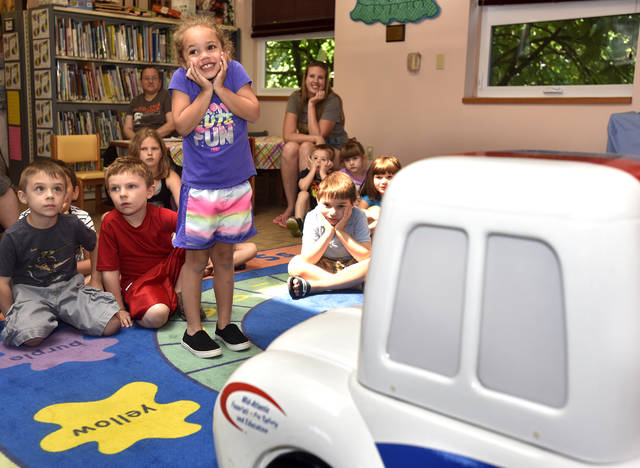
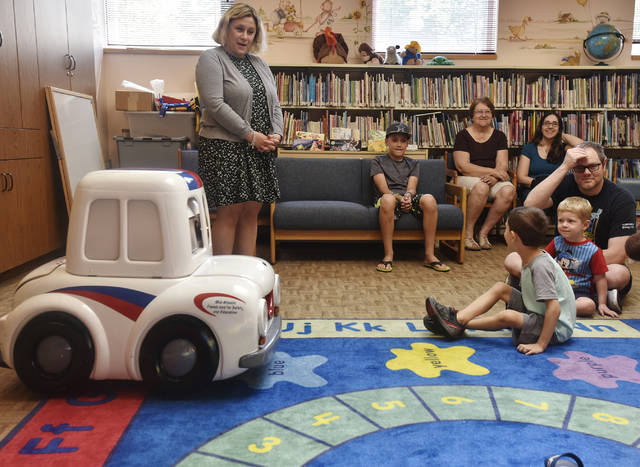
DALLAS — Otto sat quietly while nearly 20 5-and 6-year-olds entered the Children’s Library of the Back Mountain Memorial Library June 29.
Once everyone found a place to sit, Otto blinked and said hello, which caused the children to squeal and giggle with shock and excitement.
A remote-controlled white car with blue and red racing stripes from the American Auto Association, Otto and her friend Keri Kline, an assistant coordinator of the Northeast Highway Safety Program, came to the library to discuss automobile and pedestrian safety with the children.
“What is the first thing you do when you get into a car?” Otto asked.
Several boys and girls raised their hands to answer. Kline picked 5-year-old Nicholas Speicher to ansswer.
“You put on your seatbelt,” Speicher said.
Otto was pleased with the answer.
“Very good,” Otto said. “Who has to buckle up?”
Mason Dymond, 5, answered, “Everyone.
“That is right,” Otto said.
Then, Otto asked the children if they could make her a promise they would always wear seatbelts every time they got into a vehicle.
They all agreed.
“Do you sit in the front or back seat of a car?” Otto asked.
Many children answered the back.
“How old do you have to be to sit in the front seat?” Otto asked.
The children didn’t know that answer, so Otto told them they have to be at least 13 years old to sit in the front seat of an automobile.
There is something that can come out of the front of a car, Kline said.
“It is like a balloon,” Kline said. “Do you know what it is called?”
“An airbag,” Speicher answered.
Kline explained the airbag comes out of the dash of a car at 200 miles-per-hour, which is faster than a race car.
“And it is hot and could hurt you,” Kline said, adding that is why it is so important for children to sit in the back of a vehicle instead of the front.
“Let’s make another promise,” Otto said. “I promise to sit in the back seat until I am 13.”
Kline switched the conversation over to bike safety by showing the kids her bike helmet.
“My bike helmet is red,” she said as she put it on her head.
The children called out descriptions of what their bike helmets look like; some have dinosaurs on them and are various colors.
Kline then taught the children the 2-V-1 rule that will help them be sure their helmets fit properly.
First, Kline said the index and middle finger should fit in the space between their eyebrows and the bottom of the helmet as it rests on their head.
Second, the chin strap forms a v-shape on each side. One strap should be in front and the other behind the ears, she said. Kline demonstrated how her ears were in the middle of the v-shape.
Finally, one finger fit between the chin and the helmet strap.
According to state law, children are required to wear a helmet until they are 13 years old, Kline said.
“I’m going to wear mine until I’m 100,” Kline said.
Kline also told the children to always wear sneakers when they ride their bikes, not sandals or flip-flops.