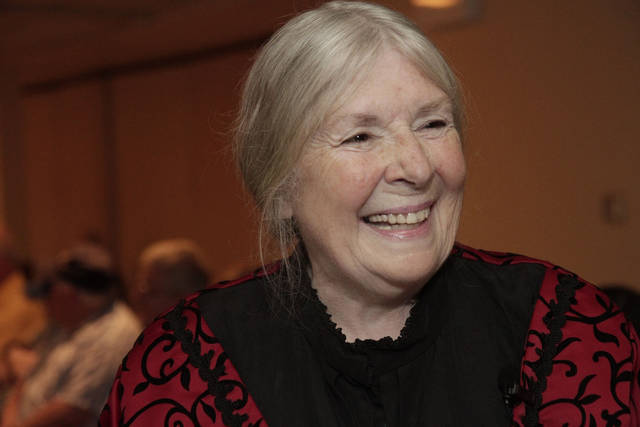
DALLAS — Screams of injured men and dying horses, gun fire, and the smells of a Civil War battlefield hospital were overwhelming, according to Meg Geffken, who portrayed Clarissa “Clara” Harlowe Barton at a Wyoming Valley Civil War Round Table meeting Thursday.
Geffken painted a vivid image of the prominent female Civil War figure, whom made it her mission to provide supplies to the troops dispatched to fight in the war, in a presentation titled “An Evening With Clara.”
Barton had several different careers in her lifetime but is known as a Civil War nurse, establishing the American Red Cross and the National First Aid Society.
“I am one of those people that when a door slams closed in your face — and you know you are doing the right thing — you just have to push that door open,” Geffken, as Barton, said to nearly 50 people at the Daddow-Isaacs American Legion Post 672.
Barton’s strong will and determination carried throughout Geffken’s portrayal. Geffken developed Barton’s character from extensive research that included reading numerous letters Barton wrote.
Teacher
Barton, born in Massachusetts in December 1821, started as a school teacher at age 15.
Barton felt she was not recognized for her merit and moved to Bordentown, New Jersey, to teach.
“I decided that in your hometown you really don’t grow,” Geffken said, in character. “You are always your father’s daughter or your brother’s little sister.”
Geffken, diving into her character, delivered Barton’s words in earnest, transforming into the historical figure before the audience.
The town did not have any public schools, and many children were uneducated because their parents could not afford tuition, she said.
Barton established Bordentown’s first public school.
“I started with six students,” she said. “Within two years, I had 600 students and a whole faculty, of which I was the principal.”
However, when the school board decided to hire a man to be principal at twice the salary, she wrote a letter of resignation.
“I explained that I might be willing, able and often did teach for free, but if a man was being paid to do a job, which I also would do, then I should be paid exactly the same as the man,” Barton said. “The school board did not think so.”
Almost 40-years-old, Barton moved to Washington, D.C., and was hired as a clerk to work in the United States Patent Office.
Barton worked in the governmental office for two years, before supervisors tried to remove her from the office because she was of the “unhireable sex,” she said.
“I refused to resign,” she said. “I was perfectly content to stay there. It was a good job, and I was paid well and I worked hard.”
After some negotiation, management decided to keep her on staff.
“At this time, our country was on the verge of the greatest war of my lifetime,” Barton said.
Civil War
She saw the “Massachusetts Company” march into Washington, D.C., and noticed several men from her hometown.
“I knew they were going off to war,” Barton said. “I knew by looking at them they were unprepared, not physically or mentally unprepared, but unprepared in the sense that — how are they going to keep uniforms clean, what if they got hurt, do they have enough food?”
Barton was motivated to help. She took a leave of absence from her job to collect supplies for soldiers.
At this time, the first battle of Bull Run occurred, she said.
“All of a sudden, buildings in Washington are now going to have to make space and be used as hospitals and areas to keep the wounded,” Barton said. “Our whole life changed.”
Barton saw the condition of wounded soldiers as they returned to Washington as well as the need for items such as bandages on the battlefield.
“It doesn’t help to take care of someone 20 hours or two days after they are wounded. You need to do it right away. You need to be there immediately,” she said. “It was the infections, the horrible unsanitary conditions that caused the loss of so many men’s lives.”
Barton reviewed a map and figured out where the troops were for the second battle of Bull Run and showed up with supplies. This is where she met Dr. James Dunn, who nicknamed her the Angel of the Battlefield.
Angel of the Battlefield
“He was so stunned (to see a woman on the battlefield),” Barton said. “He said, ‘You’re an angel.’ I said, ‘No, I’m a woman.’”
Barton described her first battlefield experience as having all of her senses on “some kind of horrible overload.”
“The sounds were unbelievable,” she said. “People were crying — men in agony, the whistling sounds of bullets, the sounds of the horses dying in the fields; there were acres of people who were wounded and suffering. The odor was unbelievable.”
It was hard to perceive piles of amputated arms and legs as human parts, she said.
She watched doctors amputating soldiers’ limbs and “putting corn husks on a stump and believing this is the best we can do.”
“It was horrendous,” she said.
Barton did receive a government-issued pass to transport supplies to the front lines and, in her travels, saw people trying to take advantage of the supplies for the troops.
She had one noted confrontation with a military officer, who threatened to take bread from her supply wagon and then whiskey.
“He said, ‘I am an officer of the United States Army and I demand the bread,’” she said. “I said, ‘I am from Massachusetts, and you are not getting it. This bread is for those soldiers.’”
The officer backed down, but not completely. He then threatened to take the whiskey, Barton said.
When there was not enough chloroform for the men who needed amputations, whiskey was used, she said.
“I’m not a drinking woman, but he was not going to take that whiskey, and I told him,” Barton said. “He said, ‘I could have you court-martialed.’ I said, ‘I could shoot you.’”
American Red Cross
Barton continued humanitarian efforts after the war ended. She took on the responsibility of tracking Civil War soldiers to reunite them with families or inform loved ones of their death, which provided closure.
Barton also kept diaries that listed supplies used, what was needed, and how supplies were acquired and delivered during the war.
A trip to Europe led Barton to discover and become involved with the International Red Cross.
In 1881, Barton established the American Red Cross Society. She was 60 years old.
At age 80, she was the head of the American Red Cross. She retired from the American Red Cross at age 86.
At age 91, Barton died in April, 1912, at her home in Glen Echo, Md.