DALLAS TWP. — Did you ever wonder how effective eye black grease is for football and baseball players?
Two Dallas Elementary School students Lorenzo and Rita Zangardi did.
In fact, the two kindergarten students used their curiosity as the basis of their experiment for the schools’ annual Arlene Besecker Memorial Science Fair held March 2.
Jen Zangardi, the boys’ mother, stood next to her children’s poster board and said the siblings, who are big sports fans, were curious if eye black grease served a purpose or “just made the players look mean.”
Lorenzo and Rita tested their theory by sitting in a dark room for five minutes and then going out into the sun. They repeated the process after smearing water under their eyes and then eye black grease.
Their conclusion was that eye black grease does help to reduce the sun’s brightness by absorbing the light.
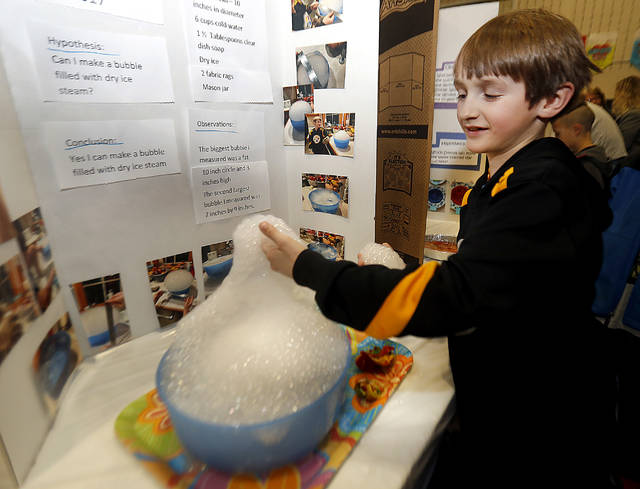
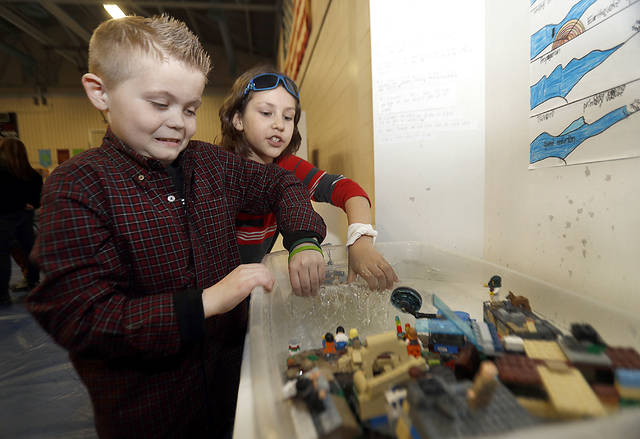
Nearly 100 Dallas Elementary School students ranging from kindergarten through sixth-grade participated in the annual fair and tested a variety of theories, including “Can a mood ring really tell your mood,” “bottle flipping,” cloud formation and much more.
Students had to use scientific methods to test their theories. Each student who participated in the fair received a certificate of participation.
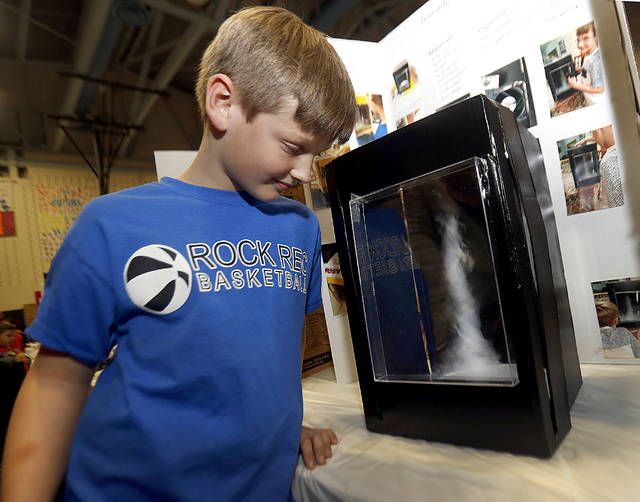
Second-grader Patrick Flanagan learned about dry ice with his tornado project.
“You have to wear heavy gloves (to work with dry ice) and keep the dry ice in a cooler packed with newspaper, so it does not evaporate,” he said as he poured a small amount of ice into a pie tin containing hot water.
The pie tin was inside a black box with a clear plastic window. The smoke created by the dry ice was funneled out of a hole in the top of a box with a small fan.
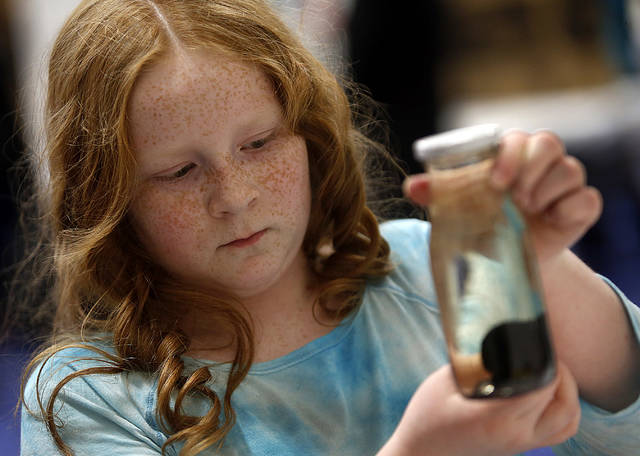
Bradie Paulewicz, a fourth-grader, demonstrated a simple way to create a lava lamp using table salt, vegetable oil, food coloring and a flashlight.
“It is very easy to make,” Paulewicz said.
She had a jar already filled with red colored vegetable oil. She held a flashlight up to the jar and added salt that created bubbles rising from the bottom of the jar to the top.
Paulewicz found the idea for the project in an “old science book” and hopes others will try the experiment at home.